
We rise early and transfer to the domestic airport for an early flight to Lukla (2,845 m). The 30 to 40 minute scenic flight offers superb views of the eastern Himalayas. Upon arrival in Lukla, we meet the rest of our trekking crew and begin our trail to Phakding (2,610 m). The walk starts along stone-paved trails toward Bhaisekharka with a few ups and downs along the way. We cross a suspension bridge over the Thado Koshi River to reach a small settlement and continue on a short, easy walk to Phakding to help our bodies adjust to the sudden rise in altitude. Overnight stay will be at a guesthouse with all meals included (B/L/D).
Everest Base Camp Trek Via Gokyo Lake

Start atKathmandu

DifficultyModerate

Ends atKathmandu

ActivityTrekking

TransporationFlight and Private Vehichle

AccomodationTea House

Duration15 dyas

Meals3X(Breakfast,Lunch,Dinner) & 3X(Tea or Coffee)

Max Altititude5,555m

Best Seasons(Mar-May)(Sep-Nov)
Everest Base Camp via Gokyo Lakes is a fascinating and adventurous trek that does not follow the classic Everest Base Camp trails. This trek is quite challenging and circular, so there is no need to return along the same path.
Since this trek takes a different route from the usual Everest Base Camp trail, it remains quiet and serene, allowing you to fully enjoy the beauty of nature.
Although the trek begins from Lukla to Namche Bazaar, as in the traditional Everest Base Camp route, the path diverges from Namche Bazaar. Instead of heading to Syangboche, it turns toward two small towns, Dole and Machhermo, ultimately leading to the Gokyo Lakes in the northwest.
Before reaching Dole, you will cross Mong La Pass (3,957 m / 12,982 ft), offering spectacular views of Mt. Ama Dablam and Mt. Khumbila. The trail passes through dense pine and rhododendron forests.
After spending the night in Dole, the trek continues to Machhermo the following day. This section is relatively gentle, with majestic views of Mt. Cho Oyu, the world’s sixth-highest mountain. Machhermo is a pasture and summer village for Sherpas, surrounded by snow-capped peaks.
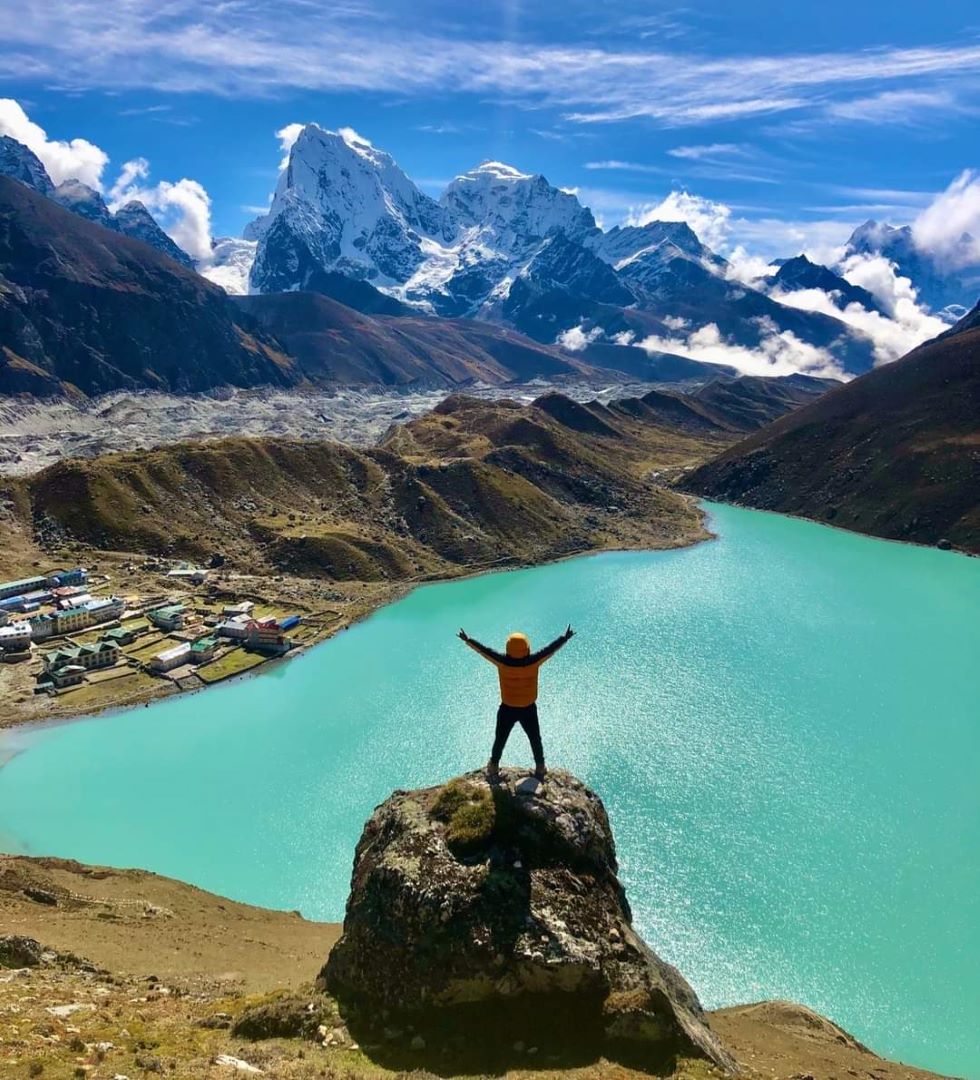
The next day, we continue from Machhermo to Gokyo Lake. The valley hosts five lakes, some of which remain partially frozen even in March or April. Gokyo Lakes are also home to golden Brahminy ducks, adding to the beauty of this already stunning location.
Gokyo Valley has a village, and as you ascend, you will encounter Gokyo Ri, one of the most famous viewpoints in the region. For the best experience, it is recommended to climb Gokyo Ri early in the morning to witness the sunrise.
The seventh day is reserved for acclimatization, as we will have reached a considerable altitude. Additionally, the Gokyo Valley is breathtaking, and one day is not enough to fully appreciate its tranquil scenery.
On the eighth day, we trek to Thangnak, covering a distance of 3.7 kilometers. The trail is rocky and uneven, with several ups and downs. Along the way, we will cross the Ngozumpa Glacier and several yak pastures before arriving at Thangnak for the night.
Early the next morning, we depart Thangnak and head toward Cho La Pass, which connects the Gokyo region with the Everest Base Camp route. A portion of this trail requires walking on the glacier itself. By reaching Cho La Pass, we will have gained over 2,000 feet in elevation, but the descent to Dzongla, our destination for the day, is comparatively easier.
From Dzongla, the trek continues to Lobuche. This segment is relatively easy and rejoins the main Everest Base Camp trail, leaving behind the more remote parts of the trek. The path follows the Khumbu Glacier for some distance and passes a memorial honoring those who lost their lives in this harsh terrain.
The eleventh day is a highlight, as we reach Everest Base Camp. To get there, we trek from Lobuche to Gorak Shep via the Khumbu Glacier lateral moraine. Upon reaching Gorak Shep, we leave our belongings at the lodge and continue to Everest Base Camp. This is the closest you will get to the world’s highest peak without climbing it.
Reaching Everest Base Camp is a remarkable achievement, requiring both physical endurance and mental determination. The experience gained on this trek often inspires a greater sense of resilience and ambition.
After spending memorable moments at Everest Base Camp, we descend to Gorak Shep for the night. Early the next morning, we hike to Kala Patthar to witness the sunrise over Mt. Everest and the surrounding Himalayan peaks. The views are surreal and provide perfect photo opportunities.
After returning from Kala Patthar, we descend to Gorak Shep for breakfast and continue to Pheriche. With the loss of altitude, the trek becomes easier, taking approximately five hours. We spend the night in Pheriche.
The following morning, we trek from Pheriche to Namche Bazaar. Although the elevation is lower, the trail is undulating, offering some of the final spectacular views of Mt. Everest. We stay overnight in Namche Bazaar.
On the fourteenth day, we hike from Namche Bazaar to Lukla, covering nearly 14 kilometers. The trail follows the Dudh Koshi River Valley, crossing several suspension bridges and high-altitude forests. Lukla marks the last night in the Khumbu region.
On the fifteenth day, after breakfast, we board a flight back to Kathmandu. We hope your journey will be comfortable and filled with memories from one of the most remarkable treks in the world.
Itinerary
Day 1
Arrival in Kathmandu (1,275 m)
Upon arrival at Kathmandu Airport, you will complete customs and visa formalities. Our representative will be waiting at the arrival gate holding an Everest View Treks display board. You will then be transferred to Hotel Manang or a similar category hotel for your overnight stay with breakfast included.
Day 2
Fly to Lukla (2,845 m) and Trek to Phakding (2,610 m)
Day 3
Phakding to Namche Bazaar (3420 m).
After breakfast in Phakding (2,610 m), we set out on our trail along the Dudh Koshi River. We walk through a magnificent forest of pine and rhododendron to reach the village of Monjo (2,835 m). From Monjo, we enter Sagarmatha National Park where our trekking permits will be checked. After completing the short trekking formalities at the park, the trail descends steeply to cross a 120-meter suspension bridge toward Jorsale (2,780 m). Along the way, we pass caravans of mules and yak transporting goods. The trail crosses the Dudh Koshi and Bhote Koshi rivers, offering magnificent views of Mt Everest peeking between Nuptse and Lhotse. We continue trekking until we enter the town of Namche Bazaar (3,420 m). Overnight stay will be at a guesthouse with all meals included (B/L/D).
Day 4
Acclimatization and Exploration in Namche Bazaar (3,420 m)
We stay in Namche Bazaar (3,420 m) for the second night to allow our bodies to acclimatize to the altitude. This is a great opportunity to explore the energetic town, the most famous trading center in the Everest region with colorful houses, restaurants, lodges and shops. We will visit the Sherpa Museum at the Sagarmatha National Park headquarters to learn about Sherpa culture, lifestyle and mountaineering heritage. Overnight stay will be at a guesthouse with all meals included (B/L/D).
Day 5
Trek from Namche Bazaar (3,420 m) to Dole (4,090 m)
From Namche Bazaar (3,420 m), our trail climbs through the village of Khumjung, a rhododendron forest and the beautiful southern slope of Khumbila. We enjoy outstanding panoramic views of Mt Ama Dablam, Mt Kangtaga and Mt Thamserku from Mong La Pass. The peak of Thamserku looms impressively in the near background. Overnight stay will be at a guesthouse with all meals included (B/L/D).
Day 6
Trek from Dole (4,090 m) to Machhermo (4,410 m)
From Dole (4,090 m), we trek to Machhermo (4,410 m) with an ascent through a scenic trail offering splendid views of Cho Oyu and Thamserku. The trail passes through a small settlement at Luza (4,340 m) as we continue our walk along the hillside above the roaring Dudh Koshi River. Overnight stay will be at a guesthouse with all meals included (B/L/D).
Day 7
Trek from Machhermo (4,410 m) to Gokyo Village (4,750 m) | 4–5 hrs
We start our trek by climbing a ridge which rewards us with beautiful views down the valley and of Thamserku, Mt Kangtenga and Cho Oyu (8,153 m). The trail drops briefly before climbing a large cave known as Nilibuk. We climb steep stairs along a narrow trail to cross a wooden bridge which leads us to the first lake, Longponga. Gokyo Village is a collection of stone houses and walled pastures on the shores of a large lake called Dudh Pokhari. The village sets a spectacular sight as it stands by the stunning lakes and Cho Oyu mountain in the background. Overnight stay will be at a guesthouse with all meals included (B/L/D).
Day 8
Hike to Gokyo Ri (5,483 m) and Return to Gokyo Village (4,750 m)
Gokyo is famous for its marvelous views and beautiful high-altitude lakes. Our acclimatization day in Gokyo is ideal for enjoying the outstanding beauty of the valley. We take a steep climb to the top of Gokyo Ri (5,483 m) which rewards us with stunning panoramic views of the entire Khumbu Himalayas including Everest, Lhotse, Nuptse, Makalu, Cho Oyu and Gyachung Kang. Gokyo Valley has six beautiful lakes. After enjoying the views, we return to Gokyo Village (4,750 m). Overnight stay will be at a guesthouse with all meals included (B/L/D).
Day 9
Trek from Gokyo (4,790 m / 15,584 ft) to Thangnak (4,700 m / 15,400 ft)
After acclimatizing for a day at Gokyo Village, we continue our trek to Thangnak (4,700 m / 15,400 ft). On the way, we pass Ngozumpa Glacier. The path has several ups and downs but is a shorter trek without significant gain in altitude. Thangnak Village sits beside Ngozumpa Glacier in a serene setting and is perfectly located for trekkers preparing to cross Cho La Pass (5,330 m). Overnight stay will be at a guesthouse with all meals included (B/L/D).
Day 10
Trek from Thangnak (4,700 m) via Cho La Pass (5,330 m) to Dzongla (4,830 m / 15,840 ft) | 7–8 hrs
Today, we trek to Cho La Pass, one of the highlights of the journey. This is one of the toughest days of the trek. The pass itself is not technically difficult but is steep and involves a glacier traverse on the eastern side. The trail is vertical in sections and ice-covered rocks make it slippery, so caution is required. We climb continuously from Phedi through a ravine and along a rocky trail. We pass the side of a frozen lake before reaching the top of the pass, decorated with prayer flags. After crossing some crevasses, we descend to Dzongla (4,830 m / 15,840 ft), a beautiful location with panoramic views of Mt Cholatse, Mt Ama Dablam, Lobuche Peak and Pheriche Village in the distance. Overnight stay will be at a guesthouse with all meals included (B/L/D).
Day 11
Trek from Dzongla (4,830 m / 15,840 ft) to Lobuche (4,940 m / 16,207 ft) | 4–5 hrs
Today, we trek to Lobuche (4,940 m / 16,207 ft). We descend from Dzongla (4,830 m) and after crossing a bridge, the trail continues through grassy terrain. We enjoy views of Lobuche Peak as we gradually climb a ridge. Mountains such as Ama Dablam, Kangtega, Thamserku and Taboche loom prominently along the way. Curving through a wide gravelly riverbed, we finally reach Lobuche. Overnight stay will be at a guesthouse with all meals included (B/L/D).
Day 12
Trek from Lobuche to Gorak Shep with Excursion to Everest Base Camp | 8–9 hrs
Today, we trek from Lobuche (4,940 m / 16,207 ft) to Gorak Shep (5,164 m / 16,961 ft) through the lateral moraine of the Khumbu Glacier. Along the trail, we pass the pyramid signpost and see the crest of the north ridge of Everest along with Mt Pumori, Mt Mahalangur, Mt Lingtren, Mt Khumbutse and Mt Nuptse. A small ascent takes us to Thangma Ri from where we enjoy a 360-degree vista of snowy mountains. Climbing steeply through the Changri Glacier, we catch our first glimpse of Kala Patthar, a grey-green knoll beneath Mt Pumori.
Upon reaching Gorak Shep, snow-capped mountains surround us, including the top of the world, Mt Everest. After a brief lunch and rest, we continue to Everest Base Camp (5,364 m / 17,594 ft) via the former Gorak Shep Lake. Along the way, we pass Indian army mountaineers' memorials and see colorful mountaineers' tents standing out against the gray terrain. From Everest Base Camp, we can view Nuptse, Khumbutse and Pumori. Everest itself is not visible from the base camp.
For the best experience, sunset at Kala Patthar offers more stunning views than sunrise. The setting sun casts golden light on the snowcapped peaks, creating a breathtaking panorama. Trekkers who wish to continue to Kala Patthar can do so today for the sunset view with the support of guides and Sherpas. Overnight stay will be at a guesthouse with all meals included (B/L/D).
Day 13
Hike to Kala Patthar and Descend to Dingboche | 7–8 hrs
We start early in the morning to witness the dramatic sunrise from Kala Patthar (5,545 m / 18,192 ft) with the first light shining on Mt Everest. Trekkers should be prepared for a dark and cold departure with temperatures ranging from -10 to -14°C and potential chilly winds. Familiar peaks such as Lingtren, Khumbutse and Changtse tower to the east as Everest gradually emerges between the west shoulder crest and Nuptse.
During the ascent, we pause at several outstanding viewpoints to catch our breath and take photographs. After several hours of climbing, we reach Kala Patthar where we scramble to the rocky outcrop near the summit marked by cairns and prayer flags. From the top, we enjoy an unbelievable Himalayan panorama, wandering visually from one mighty massif to another. We take as many pictures as possible and capture the view in our minds to last a lifetime.
After descending back to Gorak Shep for breakfast, we continue trekking down to Dingboche (4,350 m) for a well-deserved rest. Overnight stay will be at a guesthouse with all meals included (B/L/D).
Day 14
Trek from Dingboche (4,350 m) to Namche Bazaar (3,440 m / 11,283 ft) | 14 km | 5–6 hrs
We retrace the original steps of our ascent as we descend the mountain toward Namche Bazaar (3,440 m / 11,283 ft). The fascinating Sherpa culture is on display along the way, and trekkers can observe yak herding and village life. The trail is mainly downhill but includes a one-hour climb up a hill along the way. We arrive in Namche by late afternoon and rest overnight at a guesthouse with all meals included (B/L/D).
Day 15
Trek from Namche Bazaar to Phakding and Lukla | 16 km | 6–8 hrs
After breakfast, we trek toward the Hillary Suspension Bridge and pass through several local villages on the way. Arrival in Lukla (2,845 m) marks the end of the trek. This evening can be spent relaxing in a proper hotel and celebrating with your trekking crew. Thanks to great teamwork and perseverance, you have accomplished a physical feat of which many only dream. This is your last night on the mountain. Overnight stay will be at a guesthouse with all meals included (B/L/D).
Day 16
Fly from Lukla to Kathmandu
In the morning, we take a short flight from Lukla (2,845 m) to Kathmandu (1,275 m), where our journey began. Upon arrival, we transfer to our hotel for some rest and reflection after conquering the Himalayas. In the evening, we gather for a farewell dinner at one of the best Nepalese restaurants in town to share experiences and feedback from the trek. Overnight stay will be at a hotel with breakfast included (B/B).
Day 17
Fly Home and Farewell
Today marks the end of your Nepal journey as you say farewell to the mountains. We hope you enjoyed the tour and look forward to welcoming you back to the Himalayas in the future. Approximately three hours before your scheduled flight, a representative from Everest View Treks will transfer you to the airport. On your way home, you will have plenty of time to plan your next adventure in the beautiful country of Nepal.
Includes/Excludes
- All Hotel airports transfer by Private Tourist Vehichle as per itinerary.
- Kathmandu Hotel two nights with bed and breakfast plan
- Kathmandu to Lukla and Lukla to Kathmandu flight tickets for clients & guide only 15 kg luggage allowed.(10 kg big bag and 5 kg hand bag)
- .Best available lodge and tea house accommodation during the trek
- Full Board Meals(Breakfast,Lunch,Dinner)&3x(Tea or Coffee)
- A trekking or hiking leader - Fluent English speaking, experienced, knowledgeable with assistant trek guide (4 hikkers:1 assistant guide) and needed Sherpa porters (2 trekkers:1 porter) together with their payments, assurance, gears, foods and accommodations.
- All necessary national park fees, permits and paper works (Sagarmatha national park permits and TIMS) ,Entire administration and local Taxes.
- Guide and porter salary , food insurance&Gov taxes.
- Fresh Fruit after dinner &1 pcs Snicker or Mars Chocolate each person Everyday
- Trek Completion certificate
- .Complimentary Trekking Kit bag& Sleeping bag (Return after Trek)
- Farewell dinner in Kathmandu.
- Everest Region Trekking Map
- First Aid -Kit
- Nepal Visa fees on your airport arrival (You should bring accurate USD cash and two passport size picture)
- Personal expenses (Shopping, Laundry, bar bills, battery recharge, mineral water or boiled water, Phone calls, hot shower etc)
- Your Lunch and dinners in Kathmandu (This apply also early come back from trek then the fixed itinerary)
- Extra night accommodation in Kathmandu than above itinerary.
- Tips for guides and porters (Expected)
- Rescue incase emergency.
Packing List for Everest Base Camp Trek Via Gokyo Lake
- Waterproof and windproof jacket and pants
- Insulated down jacket for cold evenings
- Fleece or softshell jacket
- Thermal base layers (tops and bottoms)
- Trekking shirts (quick-dry, moisture-wicking)
- Trekking pants and shorts
- Warm hat and sun hat
- Gloves (light and insulated)
- Buff or scarf
- Socks (wool or synthetic trekking socks, plus liner socks)
- Sturdy trekking boots (waterproof, broken-in)
- Lightweight camp shoes or sandals for evenings
- Daypack (25–35 L) for daily essentials
- Sleeping bag (rated to -15°C / 5°F recommended)
- Trekking poles
- Headlamp with extra batteries
- Water bottles or hydration system (at least 2 liters)
- Sunglasses (UV protection)
- Sunscreen and lip balm with SPF
- Personal toiletries and quick-dry towel
- Basic first-aid kit (blister care, altitude sickness meds recommended)
- Personal medications and prescriptions
- Hand sanitizer and wet wipes
- Camera or smartphone with extra batteries/power bank
- Binoculars
- Lightweight gloves for photography
- Snacks, energy bars
- Travel pillow or inflatable pillow
- Main duffel bag for porters (max 15–20 kg)
- Small daypack for daily essentials
FAQs
The Gokyo Lakes route is quieter and less crowded, offering a circular trek that passes through serene high-altitude lakes, the Gokyo Valley and scenic passes like Cho La. Unlike the classic route, you experience untouched landscapes, fewer tourists and incredible viewpoints along the way.
No prior experience is strictly required but a good level of fitness and stamina is essential. The trek involves steep ascents, glacier crossings and long walking days at high altitudes, so preparation with cardio exercises, long walks and stair climbing is recommended.
The best seasons are pre-monsoon (March to May) and post-monsoon (late September to November). These months offer stable weather, clear views of the Himalayas and the lakes at Gokyo are partially frozen in early spring, creating a magical landscape.
While Everest is not visible from Gokyo Village, you get spectacular panoramic views of Cho Oyu, Lhotse, Nuptse and the surrounding peaks. For Everest views, the trek continues to Gorak Shep and Kala Patthar for sunrise or sunset vistas.
This trek is both a physical and mental adventure. Walking through pristine landscapes, crossing high passes and reaching Everest Base Camp via Gokyo Lakes is a transformative experience that strengthens resilience, confidence and appreciation for nature.
Price Per Person
USD 1,699
Package Info